

The surprising history of tweezers.
On my fascination with this mundane grooming tool that goes back farther than I could have ever imagined.

I had gone to York explicitly to see the Jorvik Viking museum, and, perhaps more importantly, its most popular and highly valued attraction: the Lloyd’s Bank Coprolite. Of course, the ‘piece’ did not disappoint, but something else caught my attention that day that has stuck with me more than any other single object from their collection: tweezers.
The Vikings used tweezers.
At first, it was one of those revelations that helped to humanize an often mythologized historical population. They were just people like us who were interested in keeping the so-called ‘runway’ between their eyebrows clear. Still, I found it interesting that such a common tool used today was not only in existence 1,200 years ago, but was evidently a normal part of everyday life.
Tweezers are not the tool most of us think of when we think of Vikings. And yet, tweezers were actually produced by Norse smiths, whereas their famed ringed swords, such as the Ulfberhts, were of Frankish make and entirely outside the Scandinavian realm’s ability to produce (so far as the evidence suggests). So, in many ways, tweezers are much more authentically ‘Viking’ than their swords, or helmets, or maille shirts. Not what you were expecting, eh?
All well and good, but then I discovered something about tweezers that really got my attention. While taking my wife through the Louvre museum in Paris—a museum I have visited a dozen times, at least—an object in the ancient Egyptian exhibit caught my eye for the first time: a pair of tweezers.

I was astounded. That the Vikings had tweezers 1,200 years ago had already impressed me, but Egyptians over 3,000 years ago? It got me asking: How old is the invention of tweezers?
It turns out, tweezers are among the earliest inventions of human civilization that we still use today in much the same way, shape, and form. The tweezers you use in the morning to pluck your eyebrows, your nose, your chin, and for some of you, your private parts, form an unbroken link between you and the deep past, as far back as pre-dynastic Egypt (around 3,100 BCE) and perhaps even farther. They were used by the Minoans, the Egyptians, the Mesopotamians, and later the Romans and pretty much everyone else.
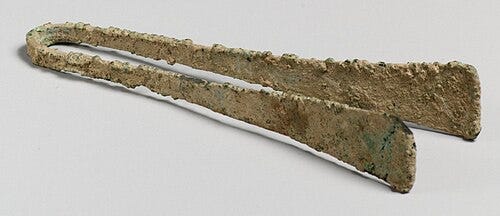
Tweezers may not be the first human tool to come to mind when we think of consequential inventions, but their persistent and frequent presence across the archeological record throughout what appears to be all of human civilization dating back over five thousand years speaks to their subtle, if generally unrecognized, importance to our lives and society—even if that importance is difficult to pin down.
And now I notice them everywhere I go, including recently at the Musée Dobrée in Nantes, where I encountered Roman tweezers:

To be honest, I don’t yet understand why I have been so captivated by such a simple little tool, except that perhaps I was surprised that something I take for granted in my morning routine has such a long and colorful history. Perhaps I just get a kick out of the idea that the reason I don’t have a unibrow is that someone in pre-dynastic Egypt decided they didn’t want one, either, and they did something about it.